Sizing
What Size Dumpster Do I Need? A Duluth, MN Guide
The 20 yard is one of our most popular sizes. How to choose between 10, 15, 20, 30 and 40 yards by volume, weight and driveway space around Duluth.
Guidelines · 8 min read
Most of what comes out of a house or a job site can go in a roll-off. The exceptions are the things Minnesota and the District keep out of the trash, or that need special handling, and each of them has somewhere else to go.
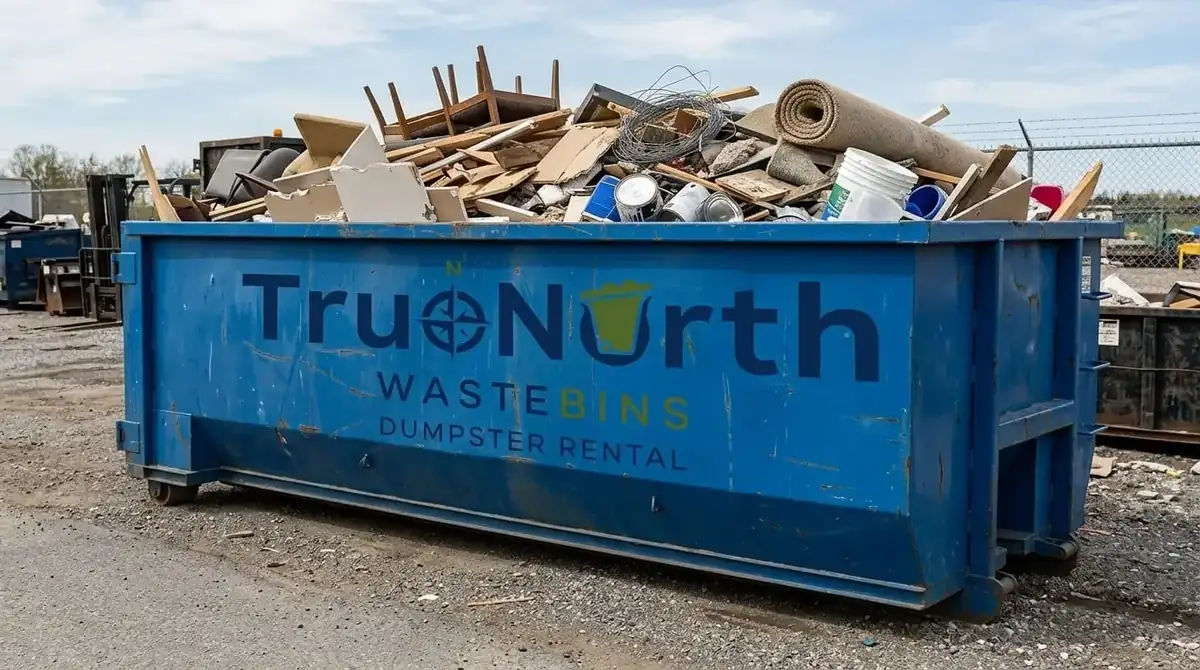
Minnesota defines demolition debris as solid waste from demolishing buildings, roads and other structures, "including concrete, brick, bituminous concrete, untreated wood, masonry, glass, trees, rock, and plastic building parts", and adds that it "does not include asbestos wastes" (Minn. R. 7035.0300 subp. 30). The District's definition is narrower: it leaves out treated wood, furniture, appliances, unattached carpet and padding, mattresses, cardboard and paints, among others, and says "Mixtures of Demolition Debris and other Solid Waste are not Demolition Debris" (WLSSD Ord. § 2.1). So a clean load of concrete or brick is a different load from a cleanout, and tell us which you have when you book.
These are the state rules that matter for a roll-off, and where each item goes instead:
| Item | The rule | What to do instead |
|---|---|---|
| Waste tires | Disposal in the land prohibited since July 1, 1985 (Minn. Stat. 115A.904) | Resource Renew Materials Recovery Center: 4 tires free per day, $4 each after that (page dated Oct 2, 2026) |
| Major appliances: fridges, freezers, washers, dryers, stoves, water heaters, AC units, dehumidifiers | No placing them in mixed municipal solid waste or disposing of them in a disposal facility; they must be recycled or reused (115A.9561) | The Materials Recovery Center takes major household appliances for a per-item fee, or our junk removal service takes appliances with proper preparation |
| TVs and monitors with a cathode-ray tube | No placing them in mixed municipal solid waste since July 1, 2006 (115A.9565) | Keep them out of the box; our junk removal service sends electronics to recycling whenever possible |
| Lead-acid batteries for cars, trucks and boats | No placing them in mixed municipal solid waste or disposing of them; a misdemeanor (115A.915) | Keep it separate; batteries are on our no list |
| Motor oil, brake, steering and transmission fluid, oil filters, antifreeze | Not in solid waste or on the land (115A.916) | Resource Renew Household Hazardous Waste Facility, free for Minnesota households |
| Yard waste: leaves, grass, brush, garden waste | Outside the metro area, not in mixed municipal solid waste or a disposal facility (115A.931) | A yard waste dumpster as its own load, or the Resource Renew Yard Waste Compost Site on Courtland St (seasonal) |
| Mercury items: thermostats, switches, fluorescent and HID lamps | Not in solid waste; fluorescent and HID lamps must be recycled (115A.932) | Household Hazardous Waste Facility, free for Minnesota households |
| Rechargeable batteries and products with a built-in rechargeable battery | No placing them in mixed municipal solid waste since August 1, 1991 (115A.9157) | Household Hazardous Waste Facility, which takes all single-use and rechargeable household batteries free |
Two common myths. Minnesota does not ban mattresses, furniture, shingles, drywall or wood from the trash, so those can go in a roll-off. And the state electronics ban covers TVs and monitors with a cathode-ray tube; the broader ban on flat screens and computers in the Duluth area is the District's local rule, below.
Inside the Western Lake Superior Sanitary District, which covers Duluth, Hermantown, Proctor, Rice Lake, Cloquet, Carlton, Scanlon, Wrenshall and Thomson Township, the District's banned-items list keeps these out of the garbage: recyclable materials, electronic waste, major appliances, tires, asbestos, hazardous waste, household hazardous waste, infectious and pathological waste, medical sharps and yard waste. Electronic waste there means equipment with a display screen or monitor 7 inches or larger, computer systems, video players, fax machines, rechargeable batteries and cell phones. That is a local rule, not a state one, but it applies to every load from the District.
The ordinance also makes the generator separate vehicle fluids, lead-acid and rechargeable batteries, tires, yard waste, hazardous waste, major appliances and problem materials from solid waste (§ 4.4.A), bars anyone from leaving waste, appliances, tires, demolition debris or yard waste on a street or right-of-way (§ 4.8.A), and requires corrugated cardboard to be separated from trash (§ 4.2.I). So flatten cardboard and keep it together, and tell us if there is a lot of it.
Our own no list: paint, solvents and oils, fuel and other hazardous liquids, tires, batteries, hazardous chemicals, gas cylinders, propane tanks and other pressurized tanks, medical waste, asbestos, and appliances containing refrigerants unless properly prepared. For a yard waste box, also leave out treated and pressure-treated wood, plastic planters, fertilizers, chemicals and bagged trash. If you are unsure about something, call (218) 522-8487 before you load it; it is far cheaper than finding out at the facility.
The bans are the hauler's business too. The District bars collectors from accepting loads that contain yard waste, batteries, mercury items, vehicle fluids and filters, waste tires, major appliances or medical waste (§ 6.3.7), and Duluth bars yard waste, motor oil, car batteries, tires, medical waste and household hazardous waste from waste set out for a licensed collector (§ 24-17.1(a)). So consider this our notice: banned items stay out of the box.
| Item | What to do with it |
|---|---|
| Paint, solvents, cleaners, degreasers, weed killers and pesticides | Resource Renew Household Hazardous Waste Facility, 2626 Courtland St, Duluth: free for Minnesota households and City of Superior residents. Businesses use the District's Clean Shop program. |
| Household batteries, single-use and rechargeable | The same facility, free. |
| Fluorescent bulbs and medical sharps | The same facility, free. |
| Propane tanks and gas cylinders | On our no list. Keep them out of the box. |
| TVs, computers, monitors and printers | Keep them out of the box. Our junk removal service sends electronics to recycling whenever possible, and City of Superior residents can use the City's free e-waste receptacle at the landfill (residents only, no business use). |
| Fridges, freezers, ranges and AC units | The Materials Recovery Center, 4587 Ridgeview Rd, takes major household appliances for a per-item fee (one microwave free per day), or our junk removal service takes appliances with proper preparation. |
| Asbestos-containing materials | Never in our boxes. Notice and removal rules are below. |
| Leaves, grass, brush and garden waste only | A yard waste dumpster as its own load, or the Resource Renew Yard Waste Compost Site on Courtland St, open typically from the third week of April to the Saturday before Thanksgiving: leaves, grass and plants free, brush and logs $10 per yard, logs cut to 4 feet, no root balls. |
Outside the District, Carlton County runs a Household Hazardous Waste Facility at its Transfer Station in Carlton for Carlton County households only, and Lake County takes household hazardous waste on Wednesdays year-round. Check your own city or county page before you plan around a drop-off.
Minnesota puts a duty on the owner, the person authorizing the work and the person doing it to remove certain items before a renovation or demolition starts (Minn. R. 7035.0805 subp. 3). The list in subpart 5 covers household furniture, unattached carpet, bedding and mattresses; household hazardous waste such as automotive fluids, lawn and garden chemicals and paint; waste tires and major appliances; mercury thermostats, switches and fluorescent and HID lamps; PCB ballasts and capacitors; refrigerators, AC units and dehumidifiers; oils; lead-acid batteries, lead pipe and lead flashing; electronics with a cathode-ray tube or a circuit board; and asbestos that must be removed. Pull those first, then the building comes down into the roll-off.
The MPCA says hazardous and other problem wastes, including asbestos, must be removed from a structure before it is renovated or demolished, and that the rule applies to all structures, including homes. For regulated buildings, which in general means everything except residences of four dwelling units or less, the MPCA needs notice at least ten working days before the work begins. Asbestos-related work at or above the state thresholds (Minn. Stat. 326.71 subd. 4) needs an MDH-licensed contractor, who must give MDH written notice at least five calendar days before the project begins (326.74). A domiciled owner of a single-family home is not required to hold a licence or pay a project permit fee for asbestos work in that home (326.72).
Minnesota's definition of demolition debris excludes asbestos wastes (Minn. R. 7035.0300 subp. 30), and the District lists asbestos on its banned-items list. Never put asbestos in a roll-off.
Across the bridge, Wisconsin keeps its own list out of landfills (Wis. Stat. 287.07): lead-acid batteries and major appliances, waste oil and used oil filters, yard waste including brush up to 6 inches in diameter, waste tires, TVs, computers, monitors, printers and other listed electronics, corrugated cardboard, newspaper, magazines and office paper, aluminum, steel and glass containers, and #1 and #2 plastic containers. The DNR says the bans apply everywhere in Wisconsin, including in homes and businesses. The electronics rule covers TVs and monitors with screens of at least 7 inches, consumer computers and printers, and peripherals (Wis. Stat. 287.17), and covered batteries join the list on January 1, 2028 (287.07(6)). The DNR defines construction and demolition waste as concrete, bricks, asphalt, wood, glass, masonry, roofing, siding and plaster, not paints, solvents, sealers or adhesives (NR 500.03(50)).
For asbestos, the owner or operator must inspect for asbestos before any demolition or renovation (NR 447.06(1)), and regulated jobs need 10 working days' notice to the DNR; a single, isolated house or a building of four or fewer units is typically exempt from the demolition notice, unless the job is part of a DOT road, commercial or industrial, or urban-renewal project, but never from the inspection. Loads must not drop, sift or leak on the road (Wis. Stat. 348.10(2)). Superior's City landfill on Moccasin Mike Rd does not take demolition or building materials, appliances, batteries, fluorescent bulbs, motor oil or household hazardous waste, so a roll-off is the practical route for remodel and demolition debris, and Superior residents can take household hazardous waste to the Resource Renew facility in Duluth free.
It pays to sort the way the rules do. A clean load of concrete, brick, rock or asphalt is demolition debris and can go to recycling. Mixed remodel and tear-out debris is a different load, and once household junk goes in with it, the District no longer counts it as demolition debris (§ 2.1). Yard waste is a third load, because Minnesota keeps it out of mixed trash (115A.931). Household junk from a cleanout is a fourth, and the one most likely to hide an old TV, a car battery or a set of tires.
So keep brush and leaves in their own load, keep heavy concrete and brick apart from everything else, flatten cardboard, and do not mix a household cleanout into a remodel box without telling us. Whenever possible, metal, concrete, asphalt, cardboard and yard debris are diverted from landfills. If you are not sure where something belongs, call before you load it.
From this guide
Yes. Minnesota does not ban mattresses from the trash, so a mattress can go in with furniture and household junk. Mattresses are bulky, so allow for the space when you choose a size.
No. Minnesota bans TVs and monitors with a cathode-ray tube from mixed trash, and in the Duluth area the District also bans screens 7 inches or larger, computers and cell phones. Our junk removal service sends electronics to recycling whenever possible.
No. Minnesota bars major appliances such as fridges, washers, dryers, stoves, water heaters and AC units from mixed trash and requires them to be recycled. The Resource Renew Materials Recovery Center takes them for a fee, or use our junk removal service.
None of them go in. Tires, lead-acid batteries and rechargeable batteries are banned from the trash in Minnesota, and paint is on our no list. Paint and household batteries go free to the Resource Renew Household Hazardous Waste Facility on Courtland St for Minnesota households.
Keep reading
The rest of the series, same approach — official sources, no filler.
Sizing
The 20 yard is one of our most popular sizes. How to choose between 10, 15, 20, 30 and 40 yards by volume, weight and driveway space around Duluth.
Permits
Driveway first: a Duluth street spot needs an Obstruction Permit, Superior needs a Public Works permit, and MnDOT has no container permit.
Cost
Duluth dumpster rentals often run $350 to $750. What a flat-rate quote covers, what moves it, and the drop-off and permit costs worth knowing.
Ready when you are
Call (218) 522-8487 with the address and what is going in. A quote and a delivery window before you hang up.
(218) 522-8487Open 24 hours, 7 days